Maple Pecan French Macarons
If fall were a flavor, I’m pretty sure it would be maple pecan. Sweet and nutty with that perfect hint of buttery goodness. Smooth shells, chewy on the inside with delicately sweet maple buttercream and crunchy pieces of pecan. Sign me up!
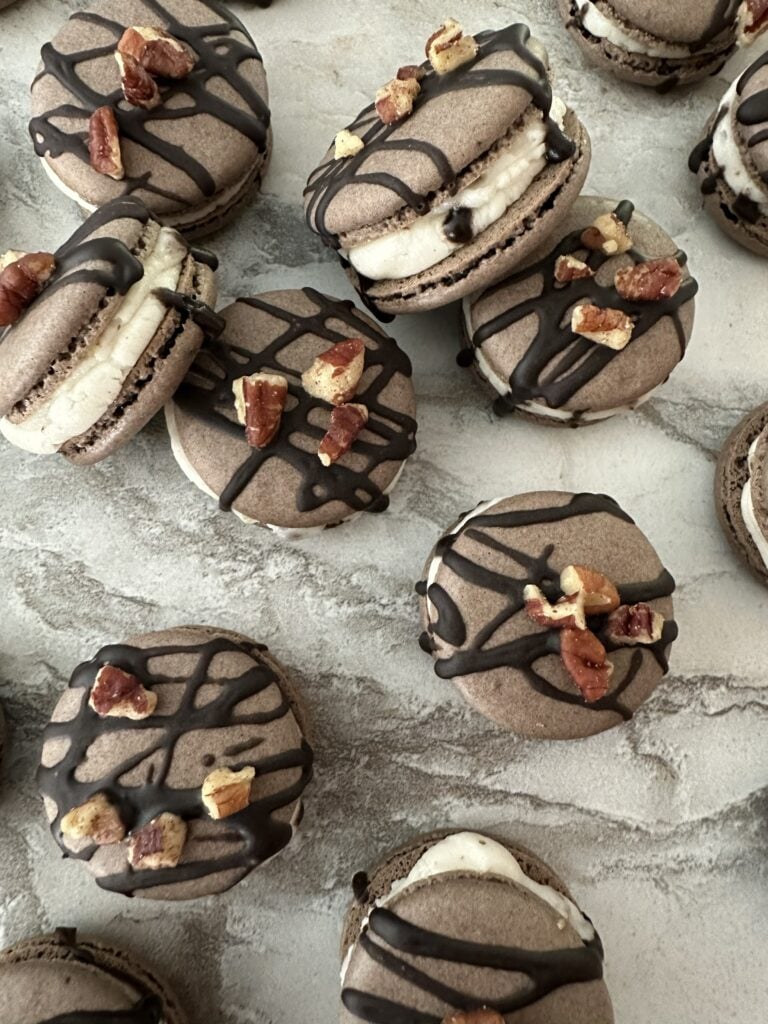
These maple pecan macarons are everything I love about fall, wrapped up in a bite-sized, slightly fancy package. The maple filling brings that deep, caramel-y sweetness, and the pecans add just enough nutty flavor to make you feel like you really know what you’re doing in the kitchen. They look like the kind of thing you’d find in a fancy bakery window, but honestly? They’re just my excuse to eat dessert for research purposes.
Don’t worry if you’ve never made macarons before — they’re not nearly as fussy as they look. Once you get the hang of the batter, you’ll be making these like a pro (or at least impressing your friends into thinking you are).
If you love the flavor of maple just as much as I do, I’ve got a few more recipes you’ll love to try. My Maple Bacon French Macarons are absolutely to die for. They taste like a mini version of breakfast. And if you love cinnamon rolls, (who doesn’t!) my easy One Rise Maple Pecan Cinnamon Rolls just might be your new favorite thing! Let’s not forget fall’s power couple-apple and cinnamon. Add some maple in there, like in my Apple Cinnamon Scones with Maple Glaze, and you’ve got flavor that can’t be beat!
Ready to make them? Don’t worry-these macarons are easier to make than they look. Check out my Basic French Macarons for Beginners post for all the tips and tricks for making the perfect macaron.
Ingredients

Just a few, high-quality ingredients are needed for macarons.
- Almond flour Make sure it’s finely sifted for those smooth shells.
- Powdered sugar Adds sweetness and helps create the smooth shells macarons are known for.
- Egg whites From fresh eggs, no liquid egg whites here. I like to separate my egg whites ahead of time. It makes the whole process flow smoother if you do this. Plus, it gives the egg white proteins a chance to relax, helping to form a stronger meringue. 24 hours ahead is great, but I also will do it the morning I am making the macarons.
- Granulated sugar Sugar helps the egg whites whip into a beautiful meringue.
- Cream of tartar Helps with the stability of the meringue.
- Here
Candace’s Tip: Be sure to only use glass or metal bowls to whip egg whites in. Plastic harbors fat residue which will prevent your egg whites from whipping into stiff peaks.
Let’s make maple pecan macarons
Step 1- Making the macaron shells
Macarons are intimidating at first, but once you get the hang of them, they become easier and easier to make. At the core, you’re just whipping egg whites into stiff peaks (the meringue), then mixing the meringue with sifted almond flour and powdered sugar to form the macaron batter, known as macaronage.
- The batter should be the consistency of honey
- Use the ‘figure eight’ test to check readiness before piping


Pro Tip: Do not use liquid egg whites or meringue powder. Liquid egg whites are pasteurized, which is not ideal for making meringue. Meringue powder is not strong enough to form and hold stiff peaks.


Step 2- Pipe and dry the shells
Once it’s ready, pipe the batter onto two baking sheets lined with silicone mats or parchment paper.
- I love silicone mats with printed circles- they’re reusable and help ensure even sizing and spacing.
- Let the macarons rest until a skin forms before baking.
Pro Tip: Macarons struggle to dry properly in humid weather. Use a fan or dehumidifier to speed up the process if needed, though you don’t want the fan blowing directly onto the shells.


Step 3- Bake the macarons
Bake at 300°F for 14 minutes (adjust as needed for your oven). The shells should feel dry to the touch and not be wiggly. Let them cool for 10 minutes at least before attempting to remove them from the pans or the tops may separate.
Step 4- Fill the macarons
Once the shells are cooled, it’s time to fill and decorate.

Filling and decorating the macarons
The filling for these maple pecan macarons is a maple buttercream with crushed pecans. I love using buttercream as a filling because it’s easy to make, but it can quickly become too sweet. I think this one is perfectly balanced and goes well with the slight amount of cocoa powder that’s in the shells.
Because this buttercream calls for crushed pecans, it’s important to use the large, round 2A Wilton tip. It’s also important to crush the pecans up smaller than you think they would need to be. I bought chopped pecans and crushed them even further before adding them to the buttercream.
Once you’ve matched the shells in pairs and flipped one over, it’s time to add about a nickel sized amount of filling to each flipped over shell. Sandwich the shells together and they’re ready for the chocolate drizzle.
The chocolate drizzle is simple to make-you’re just mixing together powdered sugar, cocoa powder, and milk. Drizzle over the macarons with a spoon or a bottle with a small tip if you want more precise lines. I personally love the freehand look that I get when using the spoon, but you can use what you’d like. Add some crushed pecans to the drizzle-it will stick once it dries-and you’ve got your delicious maple pecan macarons. Let them sit in the fridge for at least a few hours to allow the flavors to develop. I always try one beforehand, though. How can you wait??

Serving tip? Honestly, just eat them. Dessert, snack, bribe for your coworkers….whenever you feel like it, macarons are always the answer.
FAQ’s
For maximum flavor and freshness, store macarons in an airtight container on the counter for up to 24 hours. Layer them with parchment paper. Do not use wax paper as it will stick to the macarons. You don’t want to stack them too high as they are a delicate cookie. Store them the same way in the fridge for up to one week.
To freeze the shells, first lay them in a single layer on a large baking sheet to freeze. Once frozen, transfer them to a freezer-safe container. Line the container with parchment paper, and put parchment paper on each layer of macarons. Freeze them for up to one month. Thaw the macarons in the fridge overnight and decorate as normal.
To freeze-filled macarons, follow the same instructions. Not all filled macarons freeze well due to the type of filling they have. Buttercream and ganache would freeze well. Fillings like jams or curds would not hold up well after being thawed out, so it is recommended not to freeze those types.
There are a couple reasons your macarons could be cracking. If you don’t give them a long enough resting period, they could crack. Remember, they need to be dry on top. Depending on your climate, this could take anywhere from 10 minutes to over an hour. If you don’t whip the meringue to stiff peaks, it will be weak thus making the macaron shells weak and more prone to cracking. You could also have a too high oven temperature. You may want to invest in an oven thermometer to be sure your oven is set to the right temperature.
Start with making sure the meringue has stiff peaks. This helps make a strong shell that’s less prone to cracks. Be sure not to overmix or undermix the batter. This takes practice. Remember the figure eight test, and that the batter should flow like honey off the spatula. Bang the trays of filled shells on the counter to remove air bubbles. Most importantly, practice makes perfect.
More macaron recipes to try

Maple Pecan French Macarons
Ingredients
- 125 grams almond flour
- 130 grams powdered sugar
- 1 tablespoon natural cocoa powder
- 105 grams egg whites
- 75 grams granulated or castor sugar
- 1/4 teaspoon cream of tartar
Maple Buttercream
- 4 tablespoons unsalted butter
- 1 1/4 cup powdered sugar
- 1 tablespoon maple syrup
- 1 tablespoon milk
- pinch salt
- 2 tablespoons crushed pecans
Dark Chocolate Drizzle
- 1/2 cup powdered sugar
- 2 teaspoons milk or cream
- 2 teaspoons cocoa powder
- 1 tablespoon crushed pecans
Instructions
Shells
- Line two baking sheets with parchment paper or silicone mats and set aside. Weigh out the almond flour (125 grams), the powdered sugar (130 grams) and the granulated sugar (75 grams). I also set up the piping bag for when I'm done mixing the batter. I use a Wilton reusable bag and the Wilton 12 tip, which provides for greater control when piping the shells. Add the bag, with the tip, into a large cup, folding the tip up before adding it in, and fold the top down around the cup. This makes it much easier to add the batter to the bag.
- Using a fine mesh sieve, sift almond flour and powdered sugar together in a large glass or metal bowl along with the tablespoon of cocoa powder.
- Add the egg whites and 1/4 teaspoon cream of tartar to the bowl of a stand mixer. You can also use a hand mixer, but it can be tough on your hands and arms. Beat the egg whites on medium speed until they are foamy and no longer liquid. The whisk should leave track marks in the foam. Turn the speed down and add the granulated sugar in three batches, waiting a few seconds in between each addition.
- Once you've added in all of the sugar, turn the speed up to medium-high, which is between 4 and 5 on my KitchenAid stand mixer. You'll see the egg whites begin to build in volume and turn a glossy white color. The whisk will also start to leave track marks in the whites and will look thick. After a few minutes, you can stop the mixer and check for stiff peaks. If the meringue runs off the whisk, it's not ready. Keep going for another few minutes and then check for stiff peaks. If it's almost ready at this point, I'll turn the mixer up a little bit higher and let it run for 30 seconds before checking again. When the meringue is done, it will form a stiff peak when you pull the whisk out. It may have a slight curve to it, but it should not flop over. If it does, continue mixing the meringue in 30-second bursts at the higher speed and checking for stiff peaks.
- Using a rubber spatula, add the meringue to the flour/sugar mixture in three batches. It won't mix together completely until you have added all of the meringue. Continue mixing until there are no dry ingredients. We are essentially deflating the meringue and making a cohesive batter. Once the dry ingredients are completely mixed in, use a circular motion with the spatula against the side of the bowl to continue mixing the batter. Do a few circles around the bowl, then bring the spatula through the batter. Do this process a few times, then check for the 'honey-like' stage. The batter should flow off the spatula like honey without breaking. You should be able to draw a figure eight with the batter that will sink into itself in 10 seconds when done. You don't want to overmix the batter, so check for doneness after every few passes.
- Once the batter is done, add it to the piping bag. Take the cup over to the lined baking sheets. Take the bag out and, holding the top closed just above the batter, squeeze the batter down gently so it just starts coming out. Hold it a bit sideways until you get over the baking sheets. Holding the bag upright, pipe the shells onto the baking sheets. If you are using the silicone mats with the stencils, you can aim for the dot in the middle of the circle. Count to 4 while piping, then move on to the next circle. Continue this process until you have filled the sheet pans or run out of batter. If you don't have the preprinted circles, just start from the top, going across before moving down. Leave about 3 inches in between each piped circle to leave room for it to spread out.
- Now that all the shells are piped, it's on to removing the air bubbles. Bang the trays firmly on your countertop a few times. This helps to dislodge the air bubbles in the shells. I also like to go through with a toothpick and pop any remaining air bubbles I find.
- Let the shells rest so they form their skin. This should take from 30-40 minutes. In humid weather, this can take longer. If the weather is really dry, it could take less time. When the skin is formed, you'll be able to touch the tops of the macarons without getting any batter on your finger. Preheat the oven to 300 F about halfway into the shells resting.
- Now that the shells have formed their skin, it's time to bake them. Bake the sheets individually in the oven on the middle rack at 300 F for 14 minutes. The tops will be matte and they will not jiggle on their feet when they are done. Remove them from the oven and let them rest for 10 minutes before removing them to a baking rack to continue cooling down. The shells must be completely cooled down before adding the filling.
- When the shells are cooled, it's time to fill them. Match the shells by size. Flip one over of each pair.
Maple Buttercream
- Using a stand mixer or hand mixer, beat the 1/2 cup softened butter until it's smooth, about 30 seconds or so.
- Add the 1 1/4 cups powdered sugar, 1 tablespoon of maple syrup. 1 tablespoon of milk, and a pinch of salt, and blend until smooth. Blend in the 2 tablespoons of crushed pecans. You may want to start slowly, as the powdered sugar tends to fly everywhere while it's being blended.
- I like to use a Wilton 2A tip to fill these macarons to help prevent the crushed pecans from getting stuck. Add the tip to a pastry bag and fill with the maple pecan buttercream. Squeeze about a nickel-sized amount of filling onto each flipped-over shell. Gently sandwich the filled shell with its partner.
Chocolate Drizzle
- Add the 1/2 cup powdered sugar, 2 teaspoons cocoa powder, and 2 teaspoons milk into a small mixing bowl. Mix everything together until smooth.
- Using a spoon or a small squeeze bottle with a tiny tip, drizzle the chocolate glaze over the macs if desired. I prefer the free-form look of using the spoon, but if you want more precision and cleaner lines, use the squeeze bottle. Add some crushed pecans to the chocolate. They will stick to the macarons as the chocolate dries.
- After you've decorated your macarons, pop them in the fridge for a bit to let the flavors mature so you get that perfect chewy-yet-crispy texture.
- Yay! You've completed a batch of macarons! Be proud of yourself. Not everyone is willing to try their hand at baking delicate cookies.
Notes
- Beat egg whites just until stiff peaks form, then stop.
- Be careful not to overmix the batter. Once it flows like honey and passes the figure eight test, stop mixing.
- Store macarons in the fridge in an airtight container for up to 1 week for maximum freshness.
Nutrition
About Author