Fig and Honey French Macarons
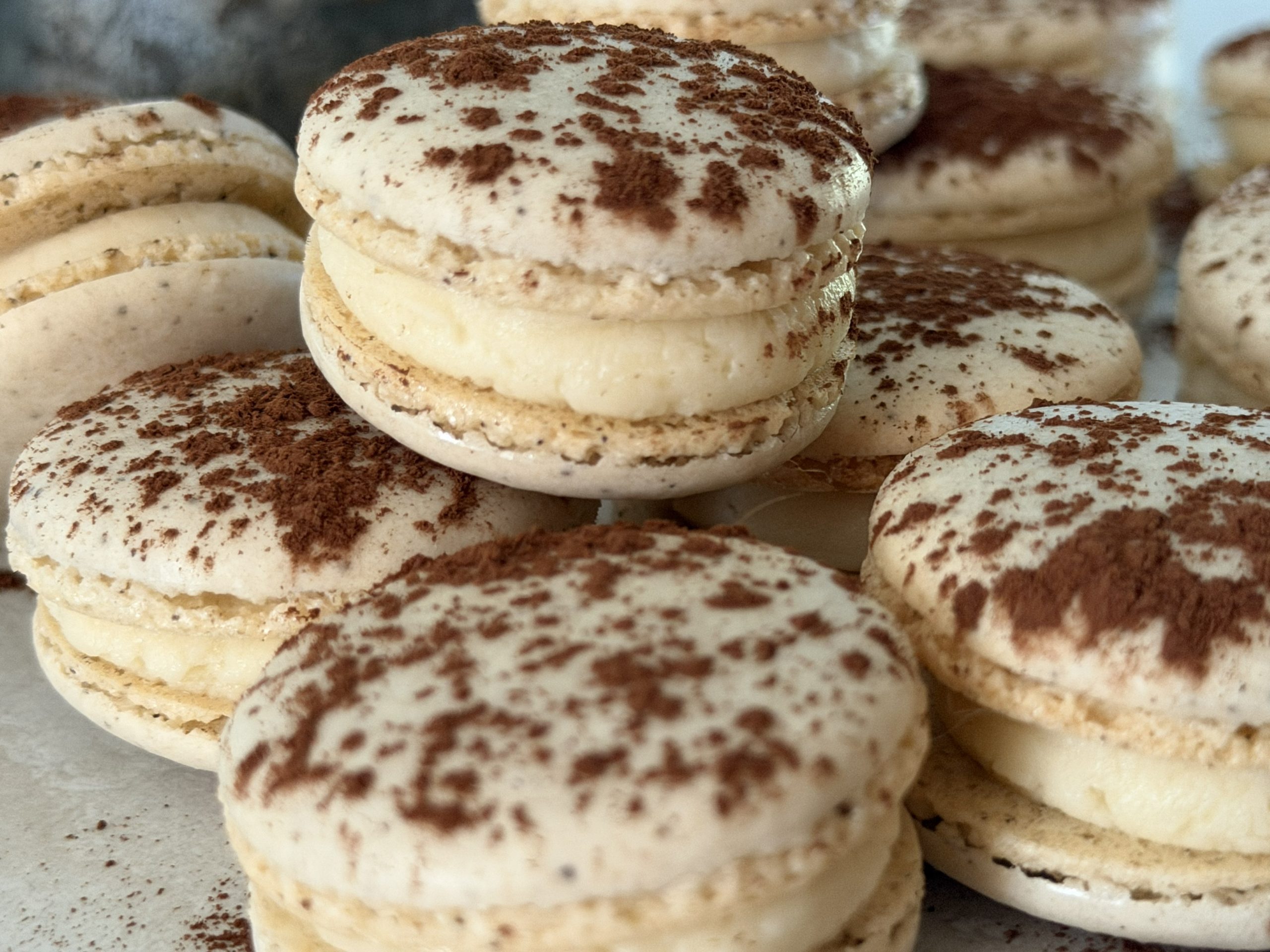
Delicately sweet honey and fig macarons are sure to impress anywhere you bring them. They’re the perfect addition to any fall brunch, or just enjoying on your own. The natural sweetness of figs and honey is perfectly balanced with cinnamon and cloves for the perfect fall treat.

I love the mix of honey and fig. It paired really well together in these macarons. I got the idea for these macarons when my friend gave me a jar of fig jam. I had never tried it before, but when I did, I knew I wanted to make a macaron out of this flavor.
I knew honey would go well with this treat as fig and honey is a popular combination. And it did not disappoint. The color of the shells came out perfectly, and the filling is sweet without being overly so.
Did you know…. Fig trees do not have any blossoms, the blossoms are inside the figs. They are what make up the tiny, edible seeds inside the fig.
Ingredients

These are the basic ingredients for macarons. Any additions like spices, flavoring, or filling will be custom to whatever flavor you are making.
- Egg Whites Whipped into a meringue, provides structure and the delicate texture macarons are known for.
- Almond flour Provides structure to our cookies.
- Powdered Sugar Adds sweetness, but also thickens the batter.
- Granulated Sugar Helps build our meringue, making it thick and glossy.
- Cream of tartar Extra assurance that the meringue will turn out perfectly.
- Extracts and spices A little bit of flavoring.
As you can see from this list, the ingredient requirement is quite short. It’s amazing what you can do with just a few ingredients. Because it’s so short, using the highest quality ingredients you can, especially egg whites and almond flour, is very important.
Pro Tips
Let’s Make This!
The following is an overview of what it takes to make these fig and honey macarons. For complete instructions, see the recipe card at the bottom of the post. You can also check out my Beginner Tutorial for French Macarons.
Separate egg whites 24 hours ahead of time. Cover with plastic, poke a few holes on top. Refrigerate. Set on counter top before you start making macs.
Candace’s Tip
Wipe down the bowls you will be using to make the meringue with vinegar or lemon juice. This will help get rid of any residual fat. I also wipe down the whisk and the bowl that I separate the egg whites into.
Weigh ingredients out- powdered sugar, almond flour, granulated sugar.
Sift together powdered sugar, almond flour, and any additions such as spices or cocoa powder.
Make the meringue. Add food coloring to the meringue, but don’t fully mix in. You’ll do this as you make the macaronage.
Mix together the meringue and flour/sugar mixture.


Macaronage is ready when it flows like honey off your spatula, you can make a figure 8 with the batter, and it sinks back into itself in 10 seconds.


Pipe onto prepared baking sheets. Let them rest at least 30 minutes, sometimes more, till they form their skin.
Bake each tray individually on the middle rack for 13 minutes at 315 F.
Remove from oven and let rest for 10 minutes before removing them to a baking rack to cool down completely.
Fill macarons once they have cooled down.

Let’s Make the Filling
The filling is a simple buttercream mixed with a bit of fig jam and honey. I started out using the Wilton 2D tip, but the jam kept getting jammed (lol!), so I switched to the round tip, which is a 2A. I also really like the 4B tip. Because I had to switch, the filling was a little softer than it would normally be. Other than that, it’s a great filling that tastes delicious.

More Recipes to Try
Frequently Asked Questions
For maximum flavor and freshness, store macarons in an airtight container in the fridge for up to one week. Layer them with parchment paper. Do not use wax paper as it will stick to the macarons. You don’t want to stack them too high as they are a delicate cookie.
To freeze the shells, first lay them in a single layer on a large baking sheet to freeze. Once frozen, transfer them to a freezer-safe container. Line the container with parchment paper, and put parchment paper on each layer of macarons. When you’re ready to use them, thaw the macarons in the fridge overnight and decorate them as normal. Freeze for up to one month.
You can also freeze filled macarons, but it depends on what they are filled with. Buttercream frosting would freeze well. Fillings such as jams or fruit curds would probably freeze ok, but they would not thaw out as well as buttercream.
Start with making sure the meringue has stiff peaks. This helps make a strong shell that’s less prone to cracks. Let the macarons form their skin. Be sure not to overmix or undermix the batter. This takes practice. Remember the figure eight test, and that the batter should flow like honey off the spatula. Bang the trays of filled shells on the counter to remove air bubbles. Most importantly, practice makes perfect.
You can use either silicone mats or parchment paper to line the baking sheets. I prefer silicone mats with the macarons stenciled on them. This helps you get the batter in the right place and perfectly spaced apart. Silicone mats also distribute heat more evenly. They are also reusable, which I appreciate as someone who bakes a lot of macarons. Plus, I love how easily the macarons release from the silicone mats. You may find as you continue on in your macaron journey, you’ll want to purchase some silicone mats. They also work really well for baking scones.

Fig and Honey French Macarons
Ingredients
- 105 grams egg whites
- 75 grams granulated or caster sugar
- 130 grams almond flour, super fine
- 130 grams powdered sugar
- 1/4 teaspoon cream of tartar
- 1 teaspoon vanilla
- 1/4 teaspoon cinnamon
- 1/4 teaspoon cloves
- 3 drops purple food coloring, 2 drops yellow food coloring, 1 drop black food coloring. Make sure it's gel food coloring, not liquid.
Fig Honey Buttercream Ingredients
- 1/4 cup butter, unsalted
- 1 1/2 cups powdered sugar
- 1 teaspoon honey
- 1 tablespoon fig jam
- pinch of salt
Instructions
- Separate the egg whites (105 grams) from the yolks about 24 hours ahead of when you will be making the macarons. Don't worry if it's not quite 24 hours. To separate the eggs, crack the shell as close to the middle as you can get. Pass the yolk back and forth between the half shells until all of the whites have separated out into your bowl. You may want to do this over a small bowl first in case some of the yolk gets into the whites.
- Line two large baking sheets with either silicone mats or parchment paper. Set them on a flat surface.
- Measure out your granulated sugar (75 grams), powdered sugar (130 grams), and almond flour (130 grams) into separate bowls. Sift the almond flour and powdered sugar together into a large glass or metal bowl, along with the cinnamon (1/4 teaspoon) and cloves (1/4 teaspoon). Use a spoon to break apart any large clumps and help sift them through.
- Using a stand mixer or an electric hand mixer with the whisk attachment, add the egg whites to a clean metal bowl. Add the cream of tartar (1/4 teaspoon) and vanilla extract (1 teaspoon). Whip the egg whites on medium speed until they become foamy and the whisk leaves track marks in them. Now it's time to add the granulated sugar. Add the sugar in 3 separate batches with the beater running on low speed. Once you've added all of the sugar, turn the beater on high.
- You will see the egg whites begin to build volume and start to look a little more solid. They will also turn a bright white color. After about 5 minutes, stop and check for doneness. They will most likely not be done and will still be runny. Continue whisking. The egg whites will start to look thick and the whisk will leave deep track marks. You are looking for the egg whites to form stiff peaks. This is when you remove the whisk from the egg whites and they come to a point without melting away. They will form a 'peak' with possibly just a slight curve. You will also be able to turn the bowl upside down and they will not move. This is the meringue. Add food coloring to the meringue but don't fully mix in, you'll do this when you make the macaronage. Use gel food coloring. (3 drops purple, 2 drops yellow, 1 drop black)
- Add the meringue to the sugar/flour mixture in three batches. No need to fully mix in between. Once you've added all the meringue, mix completely until no dry ingredients remain. We are deflating the meringue and making a cohesive batter. Once the dry ingredients are completely mixed in, use a circular motion with the spatula against the side of the bowl to continue mixing the batter. Do a few circles around the bowl, then bring the spatula through the batter. Do this process a few times, then check for the 'honey-like' stage. The batter should flow off the spatula like honey without breaking. You should be able to draw a figure eight with the flowing batter that will sink into itself in 10 seconds. You don't want to overmix the batter, so check for doneness every few passes with the spatula.
- Using a large pastry bag and a small, round tip (I like the Wilton 12 tip), fill the pastry bag with the batter. I like to use a large cup to set the bag into. Twist the bottom just above the tip and fold it over before putting it in the cup. This will prevent the batter from pouring out the bottom into the cup. Fold the sides over the cup and spoon the batter into the bag.
- Take the cup over to where your prepared pans are. Lift the bag out of the cup, hold the top closed, and gently squeeze the bag to push the batter down towards the tip. Work quickly as the batter will keep flowing out of the tip once it starts. If you have the mats with the macarons stenciled on them, then aim for the middle of each stencil. There should be a dot in the middle. Holding the bag upright, I count to four as I gently squeeze the batter onto the mat. Repeat this process until you have filled all of the circles or run out of batter.
- Bang the trays firmly on your countertop to remove any air bubbles. I also go through with a toothpick and lightly pop any air bubbles I see. Let the macarons rest for 30-40 minutes (longer if it's humid out) so they can form their 'skin'. You should be able to lightly touch the tops of the macarons without getting any batter on your finger, and they will feel smooth.
- Now it's time to bake them. Bake each tray one at a time on the middle rack for 14 minutes in a 300°F oven. The macarons will look matte on top, and they will not jiggle when you move the pan. I like to preheat my oven about halfway through the macarons resting.
- Once the macarons are done baking, let them rest for 10 minutes before removing them to a baking rack to continue cooling down. Once they're cooled down, they can be filled.
Fig Honey Buttercream
- The filling is a simple buttercream frosting. Beat the softened butter (1/4 cup) until it's smooth, about 60 seconds. Add the powdered sugar (1 1/2 cups). Beat on low until it starts to incorporate with the butter, then turn it up to medium until its fully mixed together. It will clump up. Turn the mixer off. Add the honey (1 teaspoon), and fig jam (1 tablespoon). Beat on high until everything is mixed well and the frosting is smooth.
- Fill a pastry bag with the frosting, fitted with your choice of tip. (I recommend the Wilton 4B or 2A) Match the shells by size, flipping one over of each pair. Holding the filled pastry bag upright, squeeze out roughly a nickel-sized amount onto the turned over shell. When completed, sandwich the macarons gently. I make a circular motion when sandwiching them as I don't want to press down and potentially crack the beautiful shells. Refrigerate the macarons for 24 hours to let the flavors fully develop. Honestly though, just eat one. If you don't have time to refrigerate them for that long, they're still delicious.
Notes
- For maximum flavor and freshness, store macarons in an airtight container in the fridge for up to one week. Layer them with parchment paper. Do not use wax paper as it will stick to the macarons. You don’t want to stack them too high as they are a delicate cookie.
- Do not use a plastic bowl to whip your meringue in.
- Wipe down the bowls for the meringue with vinegar or lemon juice. This will get rid of any fat residue. Also wipe the whisk down, and the bowl the egg whites are stored in.
- For best results, follow the recipe as written.
Nutrition
About Author